
Imagine this: you’ve just received your first paycheck and want to put some of it to work. You’ve heard the buzz about index funds and ETFs (exchange-traded funds). Both sound like smart ways to invest, but which one is better for you? Picking the wrong option could mean paying more in fees or missing out on flexibility.
You’re not alone in this confusion. These two investment vehicles have exploded in popularity—together holding trillions of dollars—because they give everyday investors an easy way to own a piece of the stock market without trying to guess which individual stocks will win. Instead of gambling on one “hot pick,” you can ride the market as a whole.
This guide will walk you through how index funds and ETFs work, their pros and cons, and the key differences between them. By the end, you’ll have a clear idea of which one fits your money goals—whether you’re saving for retirement, a down payment, or simply growing wealth over time.
Understanding Index Funds

Index funds changed the investing world forever. Back in the 1970s, John Bogle—founder of Vanguard—introduced them as a way for regular people to invest in the market cheaply and effectively. His philosophy was simple: instead of paying high fees to active fund managers who try to beat the market (and often fail), why not just match the market at a fraction of the cost?
That idea sparked a revolution. Today, index funds are the go-to choice for millions of investors who want steady, long-term growth without overthinking every market swing.
What Is an Index Fund?
At its core, an index fund is a type of mutual fund designed to track a specific index, like the S&P 500 or the total U.S. stock market. Instead of a manager hand-picking stocks, the fund automatically buys and holds all (or most) of the companies in the index.
For example, if the S&P 500 rises 10% in a year, your S&P 500 index fund should deliver nearly the same return.
A few things to know:
- Some index funds require a minimum investment (commonly $1,000 or more).
- Many offer automatic dividend reinvestment, so your returns compound without effort.
- They’re especially appealing for long-term investors who prefer a “set it and forget it” approach.
How Index Funds Work
Unlike stocks, index funds are only priced once per day, after the market closes. This daily price is called the NAV (net asset value)—basically, the total value of all assets divided by the number of shares.
When you buy or sell, your order processes at the NAV of that day, regardless of when you placed it. For patient, long-term investors, this slow pace isn’t a problem—it can actually help prevent emotional, knee-jerk decisions when markets swing.
Pros and Cons of Index Funds
Pros:
- Very low expense ratios (often under 0.1%).
- Built-in diversification (hundreds or thousands of stocks).
- Automatic dividend reinvestment available.
Cons:
- You can only buy/sell once per day.
- Some funds require higher minimum investments.
- Potential tax distributions even if you don’t sell shares.
💡 Pro Tip: Consider target-date index funds for retirement. They automatically adjust from stocks to bonds as you get closer to retirement age—no management needed.
Understanding ETFs
ETFs are the younger sibling of index funds. The first ETF launched in 1993 (the SPDR S&P 500), and since then, they’ve exploded in popularity—holding over $7 trillion in assets as of 2023.
ETFs combine the diversification of index funds with the flexibility of stock trading. That makes them appealing to everyone from beginners to professional traders.
What Is an ETF?
An ETF, or exchange-traded fund, is like a basket of investments (stocks, bonds, or both) that you can buy and sell on an exchange—just like you’d buy shares of Apple or Tesla.
For example:
- The Vanguard Total Stock Market ETF (VTI) lets you own thousands of U.S. stocks in one simple purchase.
- Other ETFs focus on sectors like clean energy, international markets, or even bonds.
Unlike index funds, ETFs have no large minimum investment. You can get started with as little as the price of one share—sometimes under $100.
How ETFs Work
ETFs trade throughout the day at market prices that fluctuate with supply and demand. That means you can buy at 10:00 a.m. and sell at 3:00 p.m., just like any stock.
Behind the scenes, large financial institutions (called authorized participants) help keep ETF prices in line with the index they track through a system of “in-kind” exchanges. This process also makes ETFs very tax-efficient.
Pros and Cons of ETFs
Pros:
- Trade anytime during market hours.
- Tax-efficient structure (fewer capital gains).
- Low minimums—just the cost of one share.
Cons:
- Some brokers charge commissions (though many are now free).
- Small costs from bid-ask spreads.
- Easy to over-trade if you check the market too often.
💡 Pro Tip: Use limit orders when buying ETFs to avoid paying more than you intended during market swings.
Key Differences Between Index Funds and ETFs
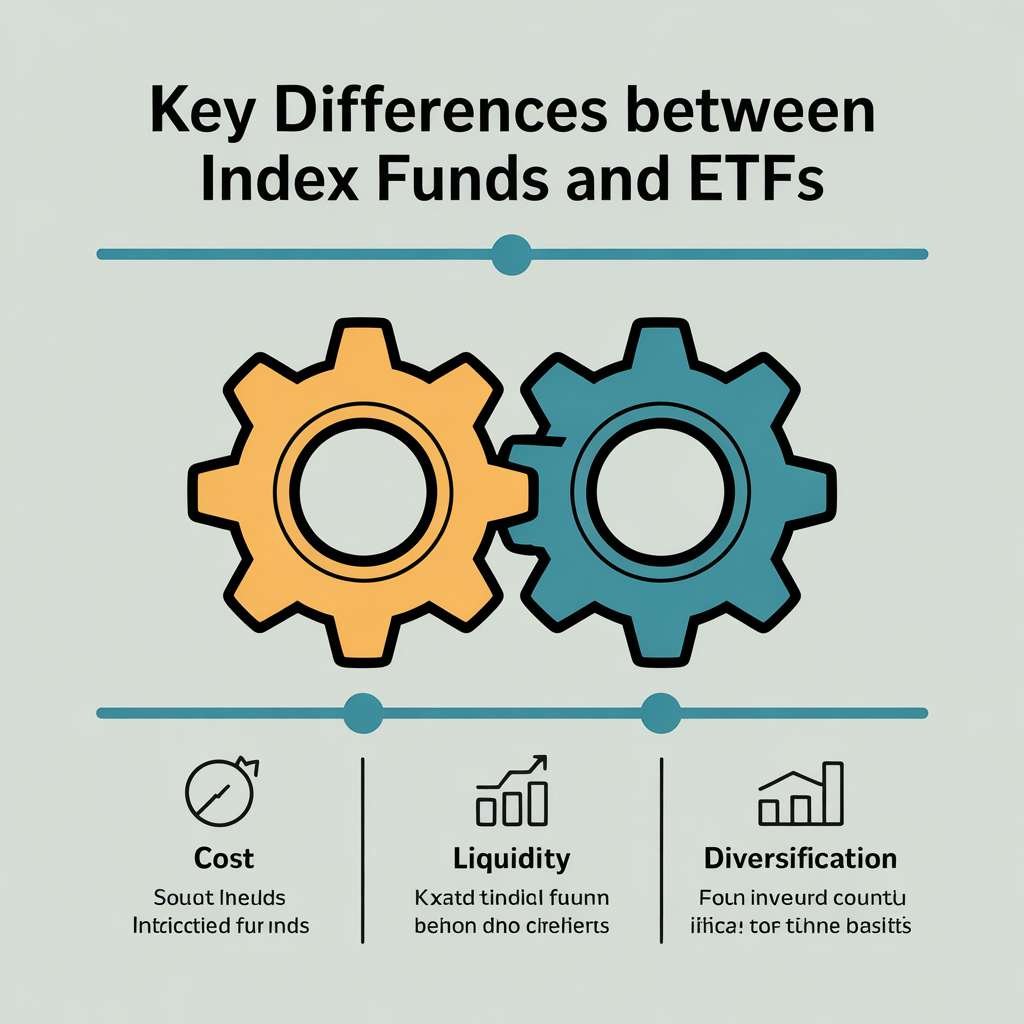
Both index funds and ETFs aim to track an index at low cost, but their structures create important differences:
Trading and Accessibility
- Index Funds: Priced once per day at NAV. Best for long-term, hands-off investors.
- ETFs: Trade in real time on stock exchanges. Great if you want flexibility or quicker access to your money.
Costs and Fees
- Both usually charge very low expense ratios (0.05%–0.20%).
- Index Funds: No bid-ask spreads, but may have minimums.
- ETFs: No minimums, but small spread costs apply.
Tax Efficiency
- ETFs are generally more tax-friendly because of their in-kind redemption system.
- Index Funds can trigger capital gains distributions even if you don’t sell shares.
Which Should You Choose?

There’s no universal answer—it depends on your goals, style, and even your personality as an investor.
Investment Goals & Time Horizon
- Index Funds: Perfect for long-term goals (retirement, education). They encourage discipline and reduce emotional trading.
- ETFs: Great for flexibility or short-to-medium-term goals. You can shift your strategy more easily.
Risk Tolerance & Strategy
- High tolerance for risk? ETFs give you the ability to fine-tune your portfolio with sector or theme-based funds.
- Prefer steady discipline? Index funds keep you from making rash moves during daily market swings.
Broker & Platform
- Some brokers make ETFs easier to buy (especially on mobile apps).
- Index funds often work better with automatic investment plans.
💡 Balanced Approach: Many investors combine both. Use index funds as your core holdings, and add ETFs for specific sectors or themes.
FAQs on Index Funds vs. ETFs
Q1. Which is better for beginners — ETFs or index funds?
Both are beginner-friendly. If you want simplicity, go with index funds. If you want flexibility and lower entry costs, choose ETFs.
Q2. Are ETFs riskier than index funds?
Not inherently. Both track indexes and carry similar market risk. The difference is mainly in how they trade.
Q3. Do ETFs or index funds pay dividends?
Yes — both can. ETFs usually pay dividends directly to you, while index funds often reinvest automatically (unless you choose cash).
Q4. Can I lose money in index funds or ETFs?
Yes. They rise and fall with the market. But historically, broad-market funds like the S&P 500 have grown significantly over decades.
Q5. Should I invest in both?
Absolutely. Many investors use index funds for long-term wealth and ETFs for flexibility or thematic investing.
Conclusion

Index funds and ETFs are both excellent tools for building wealth. They share the same foundation: low fees, broad diversification, and market-matching returns.
The choice comes down to flexibility vs. simplicity:
- Choose index funds if you want a hands-off, automatic approach.
- Choose ETFs if you prefer flexibility, tax efficiency, and the ability to trade like a stock.
Either way, starting small and investing consistently matters more than picking the “perfect” option. Over time, both can help you reach your financial goals with less stress and fewer costs.
Your future self will thank you. 🌱


Comments are closed